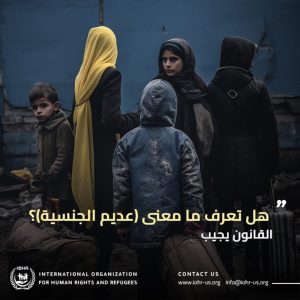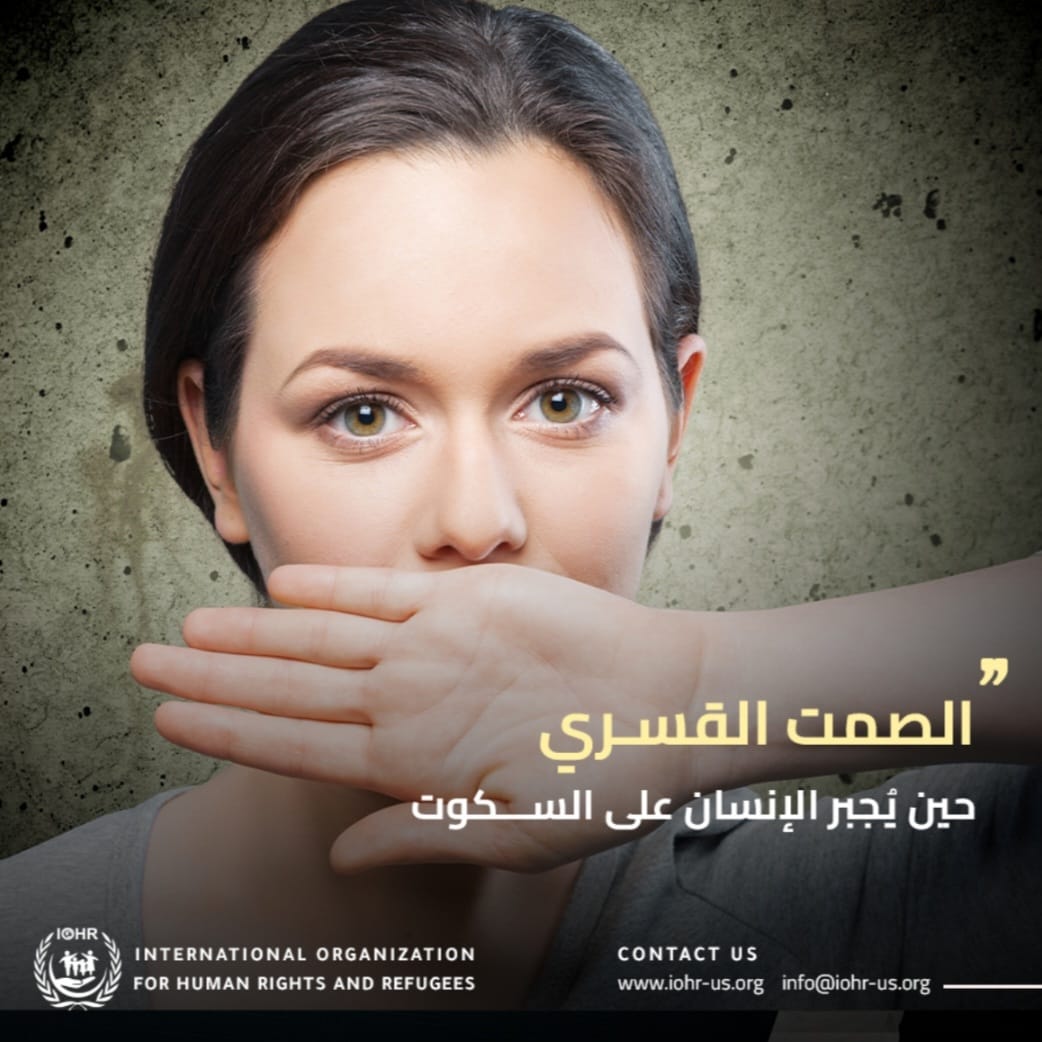
In a corner of this world, a child is born without a legal name… as if they entered life without being recorded in its ledger. Not because they do not exist, but because the paperwork has yet to acknowledge them. Here begins the story of the stateless… where a human being is transformed from a rights-bearing individual into a suspended legal question.
Who is “stateless”?
Statelessness is not a social label, but a precise legal condition defined by the United Nations High Commissioner for Refugees as:
“A person who is not considered as a national by any State under the operation of its law.”
Simply put: a human being without a nationality, without a state that recognizes them as one of its citizens. The result? An intertwined chain of deprivation that begins with the most basic rights and extends to the most complex.
How does statelessness arise?
Paradoxically, this condition does not always stem from wars; it often emerges from “quiet gaps” in legal systems. أبرزها:
Conflicting nationality laws
Between the principle of jus sanguinis (citizenship by descent) and jus soli (citizenship by birthplace), a child may fall between the two systems—like slipping between steps.
Legal discrimination
Some laws prevent women from passing their nationality to their children. If the father is unknown or stateless, the child may be born without any nationality.
State dissolution or conflict
When a political entity collapses, identity documents may disappear with it, leaving thousands in a “legal vacuum.”
Lack of birth registration
A simple procedure, yet the gateway to identity. When it is absent, it marks the beginning of a long journey of legal invisibility.
Life without nationality: living on the margins
Imagine being denied education, healthcare, or employment simply because you lack a national ID.
A stateless person lives outside “the system”—not by choice, but because the system has failed to recognize them.
Unable to travel freely
Faces difficulty owning property
Often deprived of formal education
Remains vulnerable to exploitation without effective legal protection
They exist in a grey zone… neither fully inside the state nor entirely outside it.
How does international law respond?
The law has not remained silent. It has attempted to build “bridges of recognition” through international conventions, most notably:
The 1954 Convention Relating to the Status of Stateless Persons
It established a clear legal definition of stateless persons and granted them fundamental rights such as:
The right to education
The right to work
Protection from discrimination
The 1961 Convention on the Reduction of Statelessness
It goes beyond definition toward prevention by:
Ensuring nationality for children born without one
Restricting the withdrawal of nationality if it leads to statelessness
Encouraging states to reform their laws
The role of the United Nations
Through its agencies, it works to:
Monitor cases
Support legal reforms in countries
Launch global campaigns to end statelessness (such as the #IBelong campaign)
Between law and implementation: the silent gap
Despite this legal framework, the greatest challenge lies in enforcement.
International laws are like beautifully drawn maps… but the roads on the ground are not always paved.
Some states have not ratified the conventions
Others maintain contradictory domestic laws
Administrative awareness around registration remains limited
Thus, legal texts often become promises deferred.
A modern approach: from recognition to inclusion
Contemporary legal thinking no longer focuses solely on protecting stateless persons, but on eliminating the phenomenon altogether by:
Reforming nationality laws to be more inclusive
Adopting digital civil registration systems
Removing gender- and ethnicity-based discrimination
Facilitating naturalization procedures for eligible groups
This marks a shift from “managing the crisis” to “closing the file.”
Conclusion: when a name becomes a right
A stateless person is not a statistic in a report, but a human being waiting for a simple recognition: “You exist.”
Law, at its core, is not a collection of rigid texts, but a tool to restore people to the map.
When a state grants nationality to a child who lacked it, it does not merely hand over a document… it offers a new beginning, a path to life, and the right to be called by name—without the question that precedes it: “Which country do you belong to?”